
The Four-Directional Sun
Visual Manifesto of the Cognitive Art Movement
“Knowledge without devotion is barren;
devotion without knowledge is blind.”
—Adi Shankara
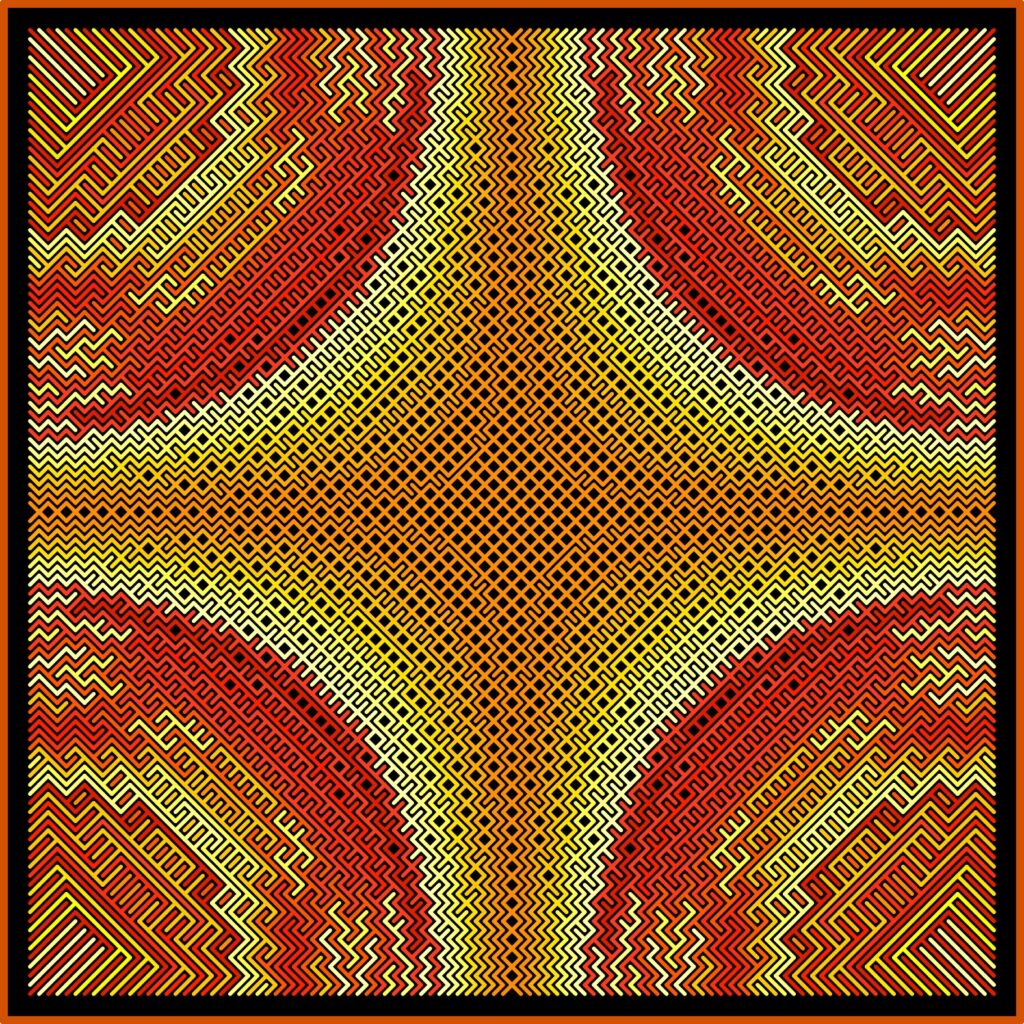
Sol de Cuatro Rumbos (versión en español)
In 2023, I unveiled the artistic series “Number as Icon,” where I transmuted numbers (from 7 to 24) into vibrant forms through mathematical concepts and methods yet to be disclosed. Now, to fully embody the Cognitive Art Movement, I present The Four-Directional Sun—a work of art woven from the frequencies of the number 107 (using the same methods).
The Four-Directional Sun is an artwork that unfolds dialogues between layers of creation. The foundational dialogue arises between the Algebraic and the Geometric, as the number 107 is granted form through its numerical essence. Next emerges an aesthetic dialogue between shape and color, where life is breathed into the creation—color transforms it into a sensory portal, revealing science without art as a lifeless skeleton. Finally, the philosophical dialogue blossoms in the interpretation infused into the work, where the creation acquires a soul through symbolism.
Philosophical Dialogue
The Four-Directional Sun reclaims the essence of three symbols to unveil a sacred synthesis: one where diversity converges into a shared language.
The Sun (universal symbol): Revered across nearly all cultures throughout history, it universally embodies life, energy, power, light, and divinity.
Four-Pointed Star (ancestral symbol): A symbolic map reflecting humanity’s quest for order in chaos, connection in diversity, and meaning in existence. Present in Mesopotamian cosmology (four divine winds), Mayan tradition (cosmic pillars of the Bacabes), Lakota spirituality (medicine wheel of life stages), and Wixárika art (Ojo de Dios), its geometry transcends borders to speak of natural cycles and sacred directions. This symbol of sacred geometry, ordering chaos, embodies universal harmonies—from Indus Valley seals to Taoist guardians in China.
The Cross (ancestral symbol): It has incarnated narratives of sacrifice, transcendence, and sacred order in cultures such as Egypt (Ankh, symbol of eternal life), Greece (material elements), Rome (martyrdom transformed into redemption), and Christianity (sacrificial love). In Teotihuacán, Quetzalcóatl’s Cross narrated cosmic eras; Celts fused it with circles to unite eternity and space; and in Buddhism, the swastika (Sanskrit: svástika) symbolized auspicious cycles long before its 20th-century appropriation. Its power lies in bridging the material and spiritual: from execution tool to transcultural icon of faith, perpetually signifying ruptures that birth new meanings.
Together, these symbols weave a map where the ancestral and universal coexist—not as opposites, but as reflections of humanity’s shared quest: to find order in mystery. The Four-Directional Sun seeks to reveal an intercultural synthesis to which humankind might aspire.
Aesthetic Dialogue
Incandescent yellows, golds, and oranges evoke the solar disk of Shamash (Mesopotamian god of justice), anchoring the work to the pursuit of truth and clarity.
Without its mathematical structure, the work would not exist—yet color sublimates it, conjuring a volumetric effect invisible in monochrome and allowing even the smallest detail to claim its existence.
Mathematical Dialogue
While traditional mathematical architecture crystallizes into static formulas, the Cymaticon project (the author’s ongoing research) employs mathematical methods to transmute numerical properties into visual vibrations, defying rigid formalism. This algorithm acts as an insurgent language: it flows beyond predictability to reveal that numerical beauty is not confined to hermetic formulas but can become dance—accessible beyond the circle of scholars.
Keeping the mathematical code secret is a political-artistic act: it challenges institutional validation’s monopoly over legitimizing art and science. The research will be disclosed and the code liberated once the artistic project matures sufficiently to transition into a pedagogical phase, nurturing the Cognitive Art Movement from its roots.
Dialogue to Embody the Cognitive Art Movement
The Four-Directional Sun is a mirror. In its edges, the fire of ancestors, the wisdom of the earth, and unwalked dreams are reflected.
The work channels my fascination with spirituality in art—as seen in Hilma af Klint, Wassily Kandinsky, Piet Mondrian, and Kazimir Malevich—but my exploration merges rational and perceptual focus, akin to Theo van Doesburg, Josef Albers, Victor Vasarely, Max Bill, Jesús Rafael Soto, Sol LeWitt, and Vicente Rojo.
Thus, the work opens a path for a new current: Idealist Abstract Art, emerging within the Cognitive Art Movement. This current does not define the Movement in full but offers a pathway for those fusing philosophical idealism with mathematical rigor. It distinguishes itself by aspiring to transcend mere representation or sensory exploration in abstraction. Instead, it elevates abstraction to a higher plane, pursuing ideal beauty grounded in mathematical-aesthetic harmony as a vehicle to transcend the material and access spiritual ideals.
Abstraction becomes a conscious vessel to access and communicate realms of pure ideas, spiritual principles, or transcendent ideals. Rooted in idealist philosophy, an artist creating under Idealist Abstract Art must perceive fundamental reality as inherently spiritual and mental. Thus, their art becomes a medium to elevate the viewer’s consciousness beyond the material world’s confines.
The Cognitive Art Movement is a broad framework, not confined to a single current like Idealist Abstract Art. Its essence lies in integrating science, art, and spirituality under the principles outlined in its Statement of Principles.
The Four-Pointed Star is an incarnated question:
Can art be a laboratory where the sacred and the scientific coexist without hierarchies?
This work does not seek your admiration—it seeks your active complicity.
LuCa Velo
April 3, 2025